
Debussy Pelléas et Mélisande
Tuesday 24 February 2026 - 20 h (Gala)
Thursday 26 February 2026 - 20 h
Saturday 28 February 2026 - 20 h
Part 1 : 1h30 | Interval : 25min | Part 2 : 1h05
Drama in 5 acts and 12 tableaux
Music by Claude Debussy (1862-1918)
Libretto by Maurice Maeterlinck based on his play Pelléas et Mélisande (1892)
Premiere: Paris, Opéra-Comique, 30 April 1902
New production
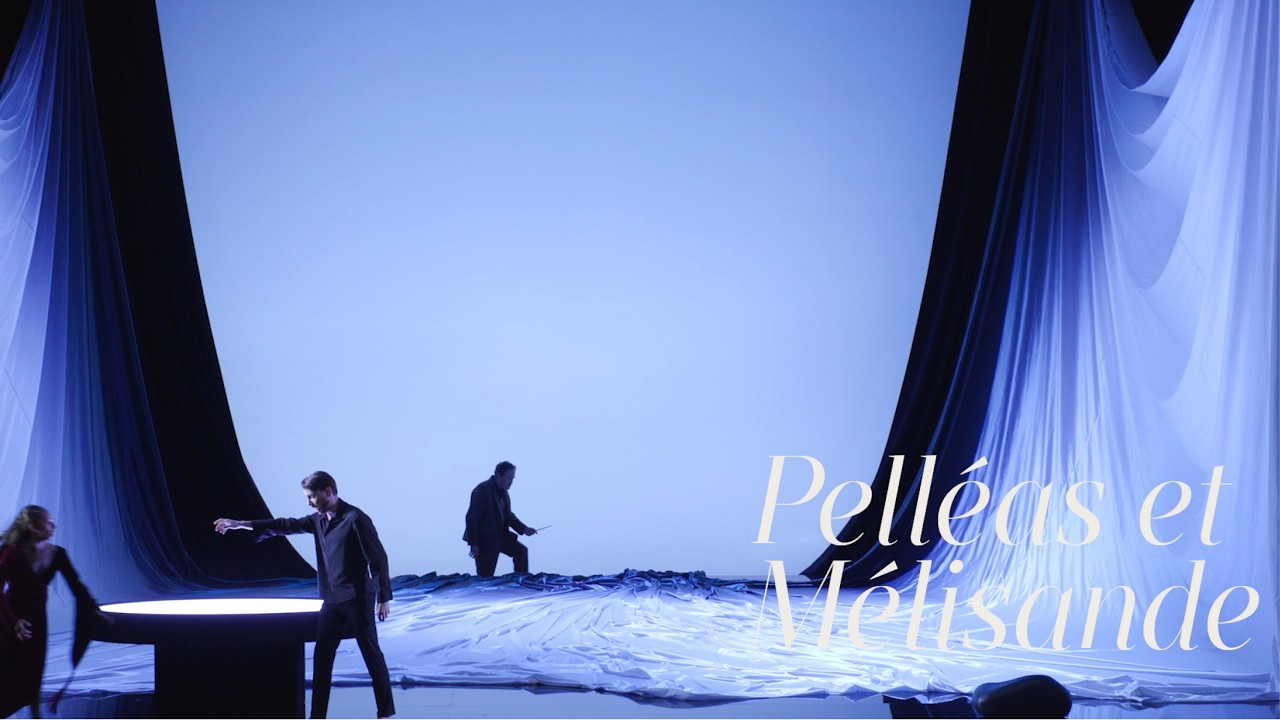
Claude Debussy’s Pelléas et Mélisande is the iconic French opera of the 20th century, and was first performed in Monaco in 1924. Its music is impressionist: the sung parts are written in a way that reflects natural dialogue in a heightened way, whereas the orchestral score contains a myriad of glittering colours and nuance. The story is based on Maurice Maeterlinck’s eponymous play, the epitomy of symbolist theatre. Set in imagined medieval surroundings, it contains basic elements of myth and fairytale, a dark castle and forest, a rigorous father and two brothers – one eager to please but unloved, the other sensitive and charming –, a blonde princess of unknown origin, who becomes the victim of the brothers’ strife, and a deep well, into which she first drops her crown, and later her wedding ring. The events unfold before us like a dream, with a constant feeling that the important things are left unspoken.
This new production of the Opéra de Monte-Carlo promises to become another fantastic collaboration on French music between Jean-Louis Grinda, Kazuki Yamada and the Orchestre Philharmonique de Monte-Carlo. Within the cast of outstanding singers, we offer you dazzling company debuts of Lea Desandre, Huw Montague Rendall and Gerald Finley.
Huw Montague Rendall and Lea Desandre appear courtesy of Erato/Warner Classics
Vidéos

Orchestre Philharmonique de Monte-Carlo

Kazuki Yamada
Born in 1979 in Kanagawa, Japan, Kazuki Yamada studied music at the Tokyo University of the Arts. He trained under Seiji Ozawa, developing what he describes as a “Japanese sensibility” in his approach to Western music. Winner of the Grand Prize at the Besançon International Competition for Young Conductors in 2009, he has since built an outstanding international career. He works regularly with the NHK Symphony Orchestra and is Principal Guest Conductor of the Yomiuri Nippon Symphony Orchestra. He has also appeared with the Orchestra of the Accademia Nazionale di Santa Cecilia in Rome, the Orchestre national du Capitole de Toulouse, and the Orchestre national de France, among others. Deeply committed to education and mentorship, he takes part each year in the Seiji Ozawa International Academy in Switzerland. Kazuki Yamada has been Artistic and Music Director of the Orchestre Philharmonique de Monte-Carlo since 2016. Since 2023, he has also served as Principal Conductor and Artistic Advisor of the City of Birmingham Symphony Orchestra. He was recently appointed Chief Conductor of the Deutsches Symphonie-Orchester Berlin. In Monaco, he has fostered a close relationship between the Orchestre Philharmonique de Monte-Carlo and the Birmingham Symphony Orchestra, leading joint projects such as Elijah (2019), Carmina Burana (2023), Verdi’s Requiem in Birmingham, and Mahler’s Second Symphony in Monaco (2024/25). His tenure in Monte-Carlo will conclude at the end of the 2025/26 season. At the Opéra de Monte-Carlo, he has conducted Samson et Dalila, La Damnation de Faust, Wozzeck, Verdi’s Requiem, L’Heure espagnole & L’Enfant et les Sortilèges, and will return in 2025 to conduct Pelléas et Mélisande.

Jean-Louis Grinda
Born in Monaco in 1960, Jean-Louis Grinda began his career in 1981 as Artistic Secretary at the Opéra d’Avignon and the Chorégies d’Orange. From 1986 to 1999, he served as Director of the Grand Théâtre de Reims. In 1996, he was appointed General and Artistic Director of the Opéra Royal de Wallonie (Liège), a position he held until 2007. There, he established an eclectic programming policy and made his directorial debut with Singin’ in the Rain, which received the 2001 Molière Award for Best Musical Production, and staged a highly acclaimed Ring cycle. Since then, he has directed more than fifty operas and musicals, from Paris to San Francisco, Tel Aviv, Montreal, Hong Kong, Santiago de Chile, Tokyo, Shanghai, Rome, and Paris. He served as Director of the Opéra de Monte-Carlo from 2007 to 2022. During these fifteen years, he notably expanded the repertoire, increased the number of performances, and implemented initiatives aimed at opening the theatre more widely to new audiences, particularly younger ones. In 2015, together with Cecilia Bartoli, he founded the orchestra-in-residence of the Opéra de Monte-Carlo, Les Musiciens du Prince – Monaco. He has also been Director of the Chorégies d’Orange from 2016 to 2026. Among his recent and ongoing projects are Lucrezia Borgia, Carmen, L’Enfant et les Sortilèges and L’Heure espagnole, La Damnation de Faust, Un ballo in maschera, and Porgy and Bess.

Laurent Castaingt
Laurent Castaingt divides his time between theatre, dance, and opera, always seeking to diversify genres and approaches. He has collaborated with a wide range of artists, including Alfredo Arias, Bernard Murat, Jean-Louis Grinda, Richard Brunel, Jean-Claude Auvray, René Loyon, as well as Karel Reisz, Japanese choreographer Hideyuki Yano, Roman Polanski, Gérard Desarthe and François Marthouret, Sylvie Testud, Laure Duthilleul, Madeleine Marion, Pierre Barrat and Marie-Noël Rio, Jean-Claude Berutti, Marie-Pascale Osterrieth, Alain Delon, among many others. He created both the set and lighting design for the stage adaptation of Virginie Despentes’ novel King Kong Theory at the Théâtre de l’Atelier (directed by Vanessa Larré). His research on light and its relationship with nature led to Écorces vives, an outdoor installation in Geneva, as well as a collaboration with illustrator François Schuiten on Planet of Visions for Expo 2000 in Hanover. He has worked on major stages around the world, including in Paris, Vienna (Volksoper), Barcelona (Liceu), Rome (Teatro Valle), Buenos Aires (Teatro Colón), and at the opera houses of Hong Kong, Valencia, Tokyo, and Dallas, as well as the Chorégies d’Orange and the Sporting de Monaco. At the Opéra de Monte-Carlo, he has lit more than twenty productions, including Carmen, Thaïs, Madama Butterfly, Il turco in Italia, Werther, La Damnation de Faust, La traviata, La Fille du régiment, La Bohème, L’Heure espagnole & L’Enfant et les sortilèges. His book exploring the role of light in stagecraft and its connection to painting, Le Théâtre de la Lumière, was published in September 2023 by Deuxième Époque.

Jorge Jara
Born in Santiago, Chile, Jorge Jara studied architecture in his hometown before moving to Berlin, where he began designing costumes for theatre, film, and opera in 1975. He has worked with directors such as Pierre Audi, Luc Bondy, Nicolas Brieger, Guy Joosten, and Nikolaus Lehnhoff. Among his many productions are What Next? (Carter) and Von heute auf morgen (Schönberg) at the Staatsoper Berlin; a Mozart cycle and Lulu in Liège; La Bohème in Lyon, Zurich, and Hamburg; Fidelio in Leipzig; Roméo et Juliette at the Metropolitan Opera; Der Cornet and Galileo in Geneva; The Tempest and Król Roger in Frankfurt; Die Zauberflöte at the Salzburg Festival; Un ballo in maschera and Orphée aux Enfers in Lausanne; L’Elisir d’amore in Amsterdam; Rigoletto in Copenhagen; La Vestale in Vienna (Theater an der Wien); and over fifteen productions at La Monnaie in Brussels. He also designed costumes for La Fille du régiment at the Royal Opera House in Muscat (Oman) and Ermione at the Rossini Opera Festival in Pesaro — a production that received the 2024 Franco Abbiati Prize from the Italian critics’ association. In 2026, he will design costumes for Piazzolla’s María de Buenos Aires at the Deutsche Oper am Rhein in Düsseldorf. At the Opéra de Monte-Carlo, he has created costumes for La Dame de pique, Le nozze di Figaro, Falstaff, La traviata, Das Rheingold, Pagliacci, Le Joueur, Tannhäuser, Lucia di Lammermoor, Thaïs, Il turco in Italia, La Damnation de Faust, and, most recently, La Fille du régiment.

Stefano Visconti
Born in Livorno (ltaly) in 1960, Stefano Visconti studied the piano and then choral conducting with Fosco Corti and Roberto Gabbiano, as well as orchestra conducting with Piero Bellugi and Giancarlo Andretta. He was appointed choirmaster at Opéra de Monte-Carlo in 2007. Before this he was choirmaster at the Teatro Goldoni, Livorno (1991-2001), Choirmaster at the Opéra-Théâtre d’Avignon (2001-2007), as well as Choirmaster at the Festival Puccini, Torre del Lago (1999-2015). From 1984 to 2001 he conducted the Guido Monaco Polyphonic Choir of Livorno which, under his direction, won several national awards (Vittorio Veneto, Arezzo and Florence competitions). In 2000 he founded the Chamber Choir of Tuscany, formed of professionals. He directed the reconstitution of the complete sacred works of Giuseppe Cambini for soloists, choir, and orchestra. Since 2008 he has conducted the choirs of the Sanxay Lyrical Evenings. He is the artistic and music director of the Monte Carlo Chamber Choir. He has made several recordings with Foné, Agora and Kikko Classics, in particular several of Mascagni’s operas (L’amico Fritz, I Rantzau, Lodoletta, Guglielmo Ratcliff, Silvano, Cavalleria rusticana, Iris and Sì). Since 2017 he has directed the coordination of the choirs for the Chorégies d’Orange festival.

Huw Montague Rendall
British baritone Huw Montague Rendall is an alumnus of the Royal College of Music of London, trained under the tutorage of Russell Smythe, David Rendall and Philip Doghan. In summer 2016 Montague Rendall was a Jerwood Young Artist with Glyndebourne Festival Opera, where he sang the role of Fiorello (Il barbiere di Siviglia), for which he was awarded the much-coveted John Christie Award 2016. The following summer he joined the prestigious Young Artist Programme at the Salzburger Festspiele and was a member of the International Opera Studio in Zürich from 2016 to 2018. Since then, he has made acclaimed debuts on some of the world’s most important stages such as the Royal Ballet & Opera in London, Lyric Opera of Chicago, Opéra National de Paris, Festival d’Aix-en-Provence, the Salzburger Festspiele or the Glyndebourne Festival. Winner of the 2024 Oper! Awards for Best Newcomer, last season saw Montague Rendall perform as Il Conte in Le nozze di Figaro at the Royal Ballet & Opera in London, and then he made his house and role debut at the Wiener Staatsoper in the title role in Billy Budd. Other engagements included a new production of Debussy’s Pelléas et Mélisande at the Opéra national de Paris, Il Conte from Le nozze di Figaro in a new production at Glyndebourne Festival and at the BBC Proms. Montague Rendall’s 25-26 season will include his debut as Dandini (La Cenerentola) at Opéra national de Paris, and a performance as Pelléas in the new production of Pelléas et Mélisande of the Opéra de Monte-Carlo.

Gerald Finley
Born in Montreal and trained in the United Kingdom at the Royal College of Music, King's College Cambridge, and the National Opera Studio, Grammy Award-winning Canadian bass-baritone Gerald Finley initially focused on Mozart's music. His Don Giovanni and Count (in Le nozze di Figaro) have been heard live and broadcast around the world. His ever-expanding repertoire quickly encompassed the great works of Wagner and Verdi, as well as roles such as Bluebeard, William Tell, J. Robert Oppenheimer in John Adams' Dr. Atomic, and Jaufré Rudel in Kaija Saariaho's L'amour de loin. A renowned recitalist, he works regularly with pianist Julius Drake. The duo has performed extensively around the world, including at the Schubertiade, in residence at Wigmore Hall, at Carnegie Hall in New York, and at the Salzburger Festspiele. Gerald Finley has also sung with Sir Antonio Pappano, Malcolm Martineau, Simon Lepper, and Michael McMahon. His numerous solo CDs are devoted to the complete song cycles of Barber, Britten, Duparc, Ives, Liszt, Ravel, and Schumann (Dichterliebe and Liederkreis). Gerald Finley's 25/26 season includes a new production of Tosca at the Royal Ballet & Opera in London, his debut at the Teatro alla Scala in the role of Don Alfonso (Così fan tutte), Amfortas (Parsifal) at the Wiener Staatsoper, Count Almaviva (Le Nozze di Figaro) and Golaud in the new production of Pelléas et Mélisande at the Opéra de Monte-Carlo.

Laurent Naouri
After studying at the Guildhall School of Music and Drama in London, French baritone Laurent Naouri was quickly engaged on numerous national stages: Bordeaux National Opera, Nancy-Lorraine National Opera, Lyon National Opera, Chorégies d'Orange, etc. He made his debut at the Paris Opera in the role of Theseus (Hippolyte et Aricie by Rameau). This opened the doors to major international venues, from La Scala to the Liceu in Barcelona, the Metropolitan Opera in New York, the Festival d'Aix-en-Provence, and the Tokyo Opera. During his career, Laurent Naouri has had the opportunity to collaborate with renowned conductors such as Sir Simon Rattle, Bernard Haitink, and Emmanuelle Haïm, in a repertoire ranging from baroque to contemporary, including Italian opera (Verdi, Puccini). He has thus been able to tackle roles as diverse as Don Pasquale (Donizetti), Falstaff (Verdi), Count Almaviva (Le Nozze di Figaro), Mephistopheles (La Damnation de Faust), the Chief of the Carabiniers (Les Brigands by Offenbach), Scarpia (Tosca), and Golaud (Pelléas et Mélisande). During the 25-26 season, Laurent Naouri will sing Sir William Crusoé (Robinson Crusoé) at the Théâtre des Champs-Élysées and Capulet (Roméo et Juliette) at the Teatro Real in Madrid, before taking on the role of Arkel at the Opéra de Monte-Carlo in a new production of Pelléas et Mélisande.

Jennifer Courcier
French soprano Jennifer Courcier is one of the most promising light sopranos of her generation, acclaimed for her vivid stage presence and the clarity of her voice. A former member of the Paris Opera’s children’s choir (Maîtrise des Hauts-de-Seine), she made her solo debut at the age of 14 in La Petite Renarde rusée (Théâtre des Champs-Élysées), Le Tour d’écrou (Nantes), and Pelléas et Mélisande (Toulouse). She trained at the CNIPAL, at the CRR de Paris with Stéphane Fuget, and later with Daniel Ottevaere. She is the winner of several competitions, including the Grand Prix Enesco in 2016. In recent seasons, she has performed on major French stages, including the Théâtre des Champs-Élysées (Yniold in Pelléas et Mélisande), the Opéras of Lyon and Marseille (Jemmy in Guillaume Tell, Fleurette in Barbe-Bleue), Lille (l’Infante in Le Nain), Tours (la Charmeuse in Thaïs), and Limoges (le Feu and la Princesse in L’Enfant et les Sortilèges). She has sung Sophie (Werther) at both the Opéra national du Rhin and the Opéra de Monte-Carlo, and Cupidon (Orphée aux Enfers) in Nantes, Nancy, and Nice. She collaborates regularly with Opera Fuoco (dir. David Stern), notably in Shanghai (Belinda in Didon et Énée) and at the Théâtre des Champs-Élysées (Fiordiligi in Così fanciulli by Nicolas Bacri). She also took part in the Académie of the Festival d’Aix-en-Provence. At the Opéra de Monte-Carlo, she has performed alongside Cecilia Bartoli in Le Comte Ory, sung Sophie in Werther, la Charmeuse in Thaïs, and portrayed une Pastourelle and la Chauve-Souris in L’Enfant et les Sortilèges. She returns in 2025 as Yniold in Pelléas et Mélisande.

Lea Desandre
“Vocal Artist of the Year” at the Opus Klassik 2022 awards and winner of the 2024 Critics’ Prize, French-Italian mezzo-soprano Lea Desandre trained in singing in Venice with Sara Mingardo before joining William Christie’s Le Jardin des Voix and the Aix-en-Provence Festival Academy in 2015. After making her debut in the world of baroque ensembles, collaborating frequently with Raphaël Pichon's Ensemble Pygmalion and William Christie's Les Arts Florissants, Lea Desandre distinguished herself in the title role of Médée (Charpentier) at the Paris Opera, as well as in the roles of Idamante (Mozart's Idomeneo), Ariodante (Handel's Ariodante), Timna (Rameau's Samson), and others. She has collaborated with directors such as Sir David McVicar, Barrie Kosky, Robert Carsen, and Claus Guth. Since 2018, she has performed annually at the Salzburger Festspiele, most recently as Myrrah/Echo in Vivaldi's Hotel Metamorphosis. She also performs in concerts around the world, from Carnegie Hall to the Philharmonie de Paris and Wigmore Hall. She regularly performs in duo with Alexandre Kantorow and Thomas Dunford. Among her upcoming engagements for 25-26, she will sing the title role in Handel's Theodora on tour with Jupiter (conducted by Thomas Dunford) and Sesto in Mozart's La Clemenza di Tito at Zurich Opera. She reprises her favorite role of Cherubino in Le Nozze di Figaro (Mozart) at the Opéra de Paris and Despina in Così fan tutte (Mozart) at the Salzburger Festspiele. She will also play Mélisande in the new production of Pelléas et Mélisande at the Opéra de Monte-Carlo.

Marie Gautrot
After studying literature at the University of Rouen and art history at the École du Louvre, Marie Gautrot entered the Conservatoire national supérieur de musique et de danse de Paris, where she studied with Marie-Claire Cottin, Pierre Mervant, Gerda Hartman, and Mireille Alcantara. An eclectic artist, she performs a wide range of repertoire, from baroque works to contemporary creations. She has sung Carmen in Grenoble, Poissy, and Caluire; Cherubino (Le nozze di Figaro) in Versailles; Ramiro (La finta giardiniera) and Dorabella (Così fan tutte) in Toulon; Maddalena (Rigoletto) in Limoges; Fenena (Nabucco) in Grenoble; Amneris (Aida) and Nicklausse (Les Contes d’Hoffmann) in Metz. At the Paris Opera, she has appeared as Emilia (Otello) and Giovanna (Rigoletto). She has also sung Mallika (Lakmé) in Rouen, la Voix de la Mère (Les Contes d’Hoffmann) in Tokyo and Lyon, Dame Marthe (Faust) in Saint-Étienne, Hedwig (Les Fées du Rhin) in Tours and Bienne/Solothurn, and Opinion publique (Orphée aux Enfers) at the Festival d’Aix-en-Provence. Upcoming engagements include Fenena in Marseille, Catarina in Fausto by Louise Bertin at the Théâtre des Champs-Élysées, and La Nonne sanglante in Saint-Étienne. At the Opéra de Monte-Carlo, she has performed Albine (Thaïs) and the Marquise de Berkenfield (La Fille du régiment); she returns in 2025 as Geneviève in Pelléas et Mélisande.
Act I
In the forest
Prince Golaud has lost his way after a hunting party. At the bend of a stream, he encounters a mysterious young woman who is crying and refuses to say who she is, where she comes from, or the cause of her sadness. She only agrees to give her name: Mélisande.
At the royal palace, Geneviève, daughter of King Arkel, reads a letter sent by her brother, Golaud, announcing happy news: although he still knows nothing about her, he has been married to Mélisande for six months. To gauge his father's reaction, he asked his half-brother Pelléas to send him a sign. Arkel does not oppose this union, although he would have preferred to see his son marry Princess Ursule, after the death of his wife, who gave him a son, Yniold, his grandfather's only reason for living.
Pelléas is torn between two duties: going to the bedside of his friend Marcellus, or choosing instead to be with his father, who is also dying. The dilemma is resolved by King Arkel, who refuses to let him leave, wanting him to welcome his half-brother Golaud to the castle, who is due to arrive with his new wife. When the royal couple's boat moors, Pelléas is tasked with escorting Mélisande. He confides in her that he will have to leave the next day. Although the two young people have only just met, Mélisande confides her sadness to Pelléas at the news of his departure.
Act II
In the castle grounds
Pelléas has taken Mélisande to a place he particularly loves: an enchanted fountain that has the power to restore sight to the blind. Mélisande, playing around, accidentally drops her engagement ring into the deep water. It is impossible to retrieve it. The first crack in a princely marriage...
At her husband's bedside, who is injured after a horse-riding accident, Mélisande confides in her unease. To comfort her, Golaud takes her hand, immediately noticing that the ring is missing... Mélisande lies, claiming to have lost the precious jewel in a cave near the sea. Golaud then orders his wife to go and find it.
Mélisande complies, once again escorted by Pelléas, who suggests that the young woman observe the cave carefully so that she can answer Golaud's questions. The two young people notice three poor men asleep, who have taken refuge in the cave.
Act III
In the castle grounds
At the window of a tower in the castle, Mélisande combs her hair while singing. Pelléas, passing by, asks her to let down her hair, while announcing to the beautiful woman that he must leave. Mélisande manages to convince him to stay and, as she smiles at the favorable response from the man she can only love in secret, her hair slips from her hands, unravels, and falls at Pelléas' feet, who kisses it tenderly. Golaud surprises them and tries to forbid this immodest and immoral gesture.
The day after this mishap, Golaud takes Pelléas to an underground passage in the castle, where a gaping chasm gives off the smell of death. Sensing his half-brother's thinly veiled threat, Pelléas flees to find fresh air. Golaud takes advantage of his position of power to forbid any further meetings with Mélisande, especially now that she is carrying his legitimate child. To ensure that his command is obeyed, Golaud orders his son, Yniold, to spy on Pelléas and Mélisande and report any suspicious activity to him.
Act IV
In the forest
Pelléas arranges to meet Mélisande at the place where they first met: the fountain of the blind, in the heart of the forest. Now that his father is cured, he has fulfilled his duty as a son. He then tells his beloved that he must leave to fulfill his duty as a friend.
At the castle, King Arkel confides in Mélisande, saddened by the gloomy atmosphere that reigns among his entourage, barely brightened by the recovery of Pelléas' father. Golaud then enters, mad with jealousy: he is convinced that Mélisande has been unfaithful to him. He threatens the young girl, leaving her there, terrified by her husband's anger.
Meanwhile, in the garden, Yniold trembles at a bad omen (the sheep are not returning to the barn), and near the fountain, Pelléas wants to repent for the harm his feelings have caused Mélisande. Yes, he loves her, and because he loves her, he must leave. Their tender farewell is interrupted by Golaud, who had decided to take it upon himself to spy on lovers. With a stroke of his sword, he takes revenge on Pelléas and rushes after Mélisande. A fatal outcome looms...
Act V
In Mélisande’s bedroom
A doctor stands at Mélisande's bedside, a few days after the tragedy. Overwhelmed by the fact that he has caused the death of his half-brother, Golaud asks to be left alone with his wife for a moment. He asks her one last time to confess her feelings for Pelléas, but the young woman refuses, preferring to take the secret of her true love to her grave. Arkel then enters the room: a child has been born from this terrible story, who, in his great-grandfather's arms, will be able to see his mother one last time before she passes away. One life begins, another ends...
Five facts to discover before the curtain rises
1
Before becoming an opera, Pelléas et Mélisande was a play by Belgian author Maurice Maeterlinck, which Claude Debussy discovered in 1892 on the recommendation of his friend Stéphane Mallarmé. It took the French composer 10 years to complete his score and sign his masterpiece, the only lyrical opus in his catalog.
2
At that time, it was common for plays to be accompanied by incidental music, performed live during the show. Thus, to accompany the European performances of the play, many composers took up the challenge: Gabriel Fauré in Paris (1898), William Wallace in Great Britain (1900), and Arnold Schönberg in Vienna (1903).
3
Although Claude Debussy had no trouble obtaining Maeterlinck's consent to transform his play into an opera, relations between the two artists became strained when the author sought to impose his mistress in the role of Mélisande. Faced with Debussy's refusal, Maeterlinck sought to mount a campaign against the creation of the opera through the press.
4
But it was not the destabilization campaign that nearly destroyed Pelléas et Mélisande. It was the reception by the press, shocked to hear about a child witnessing possible romantic encounters between adults. Although the dress rehearsal was the subject of heated debate among journalists, the premiere was well received by the general public. This shows that the press does not always reflect the tastes of the time...
5
Pelléas et Mélisande represents a major break with tradition in the history of French opera. With its style closely resembling declamation, its libretto that reproduces Maeterlinck's text almost word for word, and its composition that pushes musical tonality to its limits, the work is a unique example of modernity, which even today stands out as an exception in the world of opera.
MAÎTRES D’ŒUVRE
Direction musicale
Kazuki Yamada
Mise en scène
Jean-Louis Grinda
Décors et lumières
Laurent Castaingt
Costumes
Jorge Jara
Chef de chœur
Stefano Visconti
Chef de chant
David Zobel
Assistant à la direction musicale
Felix Benati
Assistante à la mise en scène
Vanessa d'Ayral de Sérignac
Assistante aux décors
Eleonora Rodigari
Assistant aux costumes
Quentin Gargano Dumas
SOLISTES
Pelléas
Huw Montague Rendall
Golaud
Gerald Finley
Arkel
Laurent Naouri
Yniold
Jennifer Courcier
Mélisande
Lea Desandre
Geneviève
Marie Gautrot
Un médecin
Przemyslaw Baranek
Un berger
Stefano Arnaudo
ENFANTS
Charlotte GRANGIE (22 & 24/02)
Emilie VIENNE (26 & 28/02)
FIGURATION
Maud BOISSIÈRE
Barbara FRANCH
Alexandre LAMIA
Pierre LEPAGE
Alain LOUIS-JACQUET
Stéphane MARTIN
Laurence MEINI
Jeremy RODRIGUEZ
Paola SCALTRITI
Emma TERNO
Julia ZOLYNSKI
CHŒUR DE L’OPÉRA DE MONTE-CARLO
Chef de chœur
Stefano Visconti
Consultant pour l’organisation musicale & assistant chef de chœur
Aurelio Scotto
Régisseuse du chœur & bibliothécaire
Colette Audat
Sopranos I
Galia BAKALOV
Antonella CESARIO
Chiara IAIA
Giovanna MINNITI
Felicity MURPHY
Ronja Weyhenmeyer
Sopranos II
Rossella ANTONACCI
VITTORIA GIACOBAZZI
Valérie MARRET
Letizia PIANIGIANI
Laura Maria ROMO CONTRERAS
Mezzo-sopranos
Carlo Mattioli
Géraldine MELAC
Suma MELLANO
Federica SPATOLA
Altos
Maria Carmen Ciuffreda
ORNELLA CORVI
Maria-Elisabetta DE GIORGI
Catia PIZZI
Rosa TORTORA
Ténors I
Walter BARBARIA
Francis Joseph Biyong Nguene
Lorenzo CALTAGIRONE
Vincenzo DI NOCERA
Thierry DIMEO
Nicolo LA FARCIOLA
Ténors II
Andrea Civetta
Fabio MARZI
Manuel Murabito
Adolfo SCOTTO DI LUZIO
Salvatore TAIELLO
Barytons
Przemyslaw Baranek
Fabio BONAVITA
Giulio Ceccarelli
Vincenzo CRISTOFOLI
Basses
Stefano Arnaudo
Daniele Del Bue
Edgardo RINALDI
Matthew THISTLETON
Giuseppe Zema
ORCHESTRE PHILHARMONIQUE DE MONTE-CARLO
Directeur artistique et musical
KAZUKI YAMADA
Régisseur Général
Frédéric Vitteaud
Régisseur
Samantha Raymondis
Régisseur technique
Patrick Pastor
Techniciens de scène
Jean-Marie Pastor
Mathieu Dubourg
Bibliothécaires
Orianne Planquart
Célia Giaccardi
Premiers violons
David Lefèvre (supersoliste)
Liza Kerob (supersoliste)
Sibylle Duchesne
Ilyoung Chae
Diana Mykhalevych
Mitchell Huang
Thierry Bautz
Isabelle Josso
Morgan Bodinaud
Milena Legourska
Jae-Eun Lee
Adela Urcan
Evgeny Makhtin
Rennosuke Fukuda
Andry Richaud
Cécile Subirana
NN
Seconds violons
Peter Szüts
Nicolas Delclaud
Dimitri Isakov
Frédéric Gheorghiu
Nicolas Slusznis
Alexandre Guerchovitch
Gian Battista Ermacora
Laetitia Abraham
Katalin Szüts-Lukacs
Eric Thoreux
Raluca Hood-Marinescu
Andriy Ostapchuk
Sofija Radic
Hubert Touzery
Altos
François Méreaux
Federico Andres Hood
François Duchesne
Charles Lockie
Mireille Wojciechowski
Sofia Timofeeva
Tristan Dely
Raphaël Chazal
Ying Xiong
Thomas Bouzy
Ruggero Mastrolorenzi
Sophie Mouson
Violoncelles
Thierry Amadi
Delphine Perrone
Alexandre Fougeroux
Florence Riquet
Bruno Posadas
Thomas Ducloy
Patrick Bautz
Florence Leblond
Thibault Leroy
Caroline Roeland
Contrebasses
Matthias Bensmana
Tarik Bahous
NN
Mariana Vouytcheva
Jenny Boulanger
Sylvain Rastoul
Eric Chapelle
Dorian Marcel
Flûtes
Anne Maugue
Raphaëlle Truchot Barraya
Delphine Hueber
Piccolo
Malcy Gouget
Hautbois & cor anglais
Matthieu Bloch
Matthieu Petitjean
Martin Lefèvre
Ho Ting Tsui
Clarinettes
Marie-B. Barrière-Bilote
Véronique Audard
Petite clarinette
Diana Sampaio
Clarinette basse
Augustin Carles
Bassons
Arthur Menrath
Jules Postel
Michel Mugot
Contrebasson
Frédéric Chasline
Cors
Patrick Peignier
Andrea Cesari
Didier Favre
Bertrand Raquet
Laurent Beth
David Pauvert
Trompettes
Matthias Persson
Gérald Rolland
Samuel Tupin
Rémy Labarthe
Trombones
Jean-Yves Monier
Gilles Gonneau
Ludovic Milhiet
Tuba
Florian Wielgosik
Timbales & Percussions
Julien Bourgeois
Mathieu Draux
Antoine Lardeau
Noé Ferro
Harpe
Sophia Steckeler
PERSONNEL DE SCENE
Directeur technique
Olivier Perin
Directeur de scène
Xavier Laforge
Régisseur principal
Elisabetta Acella
Régisseur de scène
Karine Ohanyan
Régisseur effets lumières
Léa Smith
Régisseur sur-titrage
Sarah Caussé
Régisseur enfants
Laëtitia Estiot
Chefs machinistes
Olivier Kinoo
Yann Moreau
Chefs machinistes adjoints
Stephane Gualde
Franck SATIZELLE
Machiniste décorateur
Laurent Barcelo
Machiniste serrurier
Schama Imbert
Pupitreurs machinerie
Jean-Philippe Faraut
David M‘Bappé
Techniciens de plateau
Tom AYRAULT
Heathcliff BONNET
Samuel CHARIERAS
Jean François CHOPIN
Morgan DUBOUIL
Franz FILLIERE
Nicolas MANCEL
Khalid NEGRAOUI
Scott TASSONE
Camille TAULELLE
Chef électricien et vidéo
Benoît Vigan
Chef électricien adjoint
Gaël Le Maux
Pupitreurs lumières
Grégory Masse
Marie-Louise Suaud
Techniciens audio vidéo
Matteo Gesta
Felipe Manrique
Electriciens de spectacle
Guillaume BREMOND
Thibault CALIGARIS
Grégory CAMPANELLA
Florian CAPELLO
Marine GENNA COSTA
Romain LA BARBERA
Chef accessoiriste
Audrey Moravec
Chef accessoiriste adjoint
Franck Escobar
Accessoiristes
Landry BASILE
Roland BIREN
Nicolas Leroy
Chef costumière-habilleuse
Eliane Mezzanotte
Chef costumière-habilleuse adjointe
Emilie Bouneau
Chef Habilleuse adjointe
Stéphanie Putegnat
Couturiers habilleurs
Roxane AVELLO
Christian CALVIERA
Florence CHAPUIS RINALDINO
Lili FORTIN
Edwige GALLI
Julie JACQUET
Karinne MARTIN
Lauriane SENET
Véronique TETU
Chef perruquière-maquilleuse
Déborah Nelson
Chef maquilleuse adjointe
Alicia Bovis
Coiffeuse
Corinne PAULÉ
Maquilleurs
Sophie KILIAN TERRIEN
Agnès Lozano
Francine RICHARD
Billetterie
Responsable billetterie
Virginie Hautot
Responsable adjointe billetterie
Jenna Brethenoux
Service billetterie
Ambre Gaillard
Dima Khabout
Assmaa Moussalli
Œuvre symboliste et mystérieuse, Pelléas et Mélisande ne s’apprivoise pas facilement. Et d’ailleurs, est-il possible de l’apprivoiser, de le comprendre? Aucun temps, aucun lieu…rien n’est précis. La musique a l’air de sortir de l’ombre pour entrer dans la lumière. Ce sera donc une clé de la scénographie. Mais pour le reste…comment expliquer ce qui se refuse à nous? Nous sommes dans les brumes, les personnages sont des figures indécises, presque déréalisées. Ils errent comme des somnambules et prononcent des phrases aussi magnifiques que mystérieuses. Leur monde ne peut se réduire à une apparence concrète et rassurante. Il faut donc tenter l’aventure de l’inconscient, des sensations et utiliser plusieurs dimensions envisageables du récit: réelles, imaginaires, sensorielles…
Maeterlinck nous invite à explorer un univers d’impressions provoquées.
Debussy, ainsi que l’écrit si bien Gaston Bachelard, « compose aux confins de la poésie et du silence ».
Baudelaire, précurseur du symbolisme, nous fait ressentir la fameuse scène de la tour trente ans avant sa création:
« Laisse-moi respirer longtemps, longtemps, l’odeur de tes cheveux, y plonger tout mon visage, comme un homme altéré dans l’eau d’une source, et les agiter avec ma main comme un mouchoir odorant, pour secouer les souvenirs dans l’air. »
Pelléas et Mélisande nous invite à cette poésie.
Jean-Louis Grinda
Mise en scène
Pelléas et Melisande est forcément une oeuvre qui nécessite le déploiement d’un univers visuel très particulier. Pour le scénographe et l’éclairagiste autant que pour le metteur en scène, les didascalies de Maeterlink et les sonorités de Debussy font appel à un imaginaire de mystère et d’illusion. Il y a également quelque chose de difforme dans ces personnages, qui touche presque à l’irreprésentable.
Représenter ces choses-là sur une scène n’est pas un travail d’illusionniste. Il ne s’agit pas de tricher avec l’oeil. Il faut organiser un espace où l’invisible agit dans le visible, non par apparition mais par suspension, retrait, décentrement. C’est chercher à rendre pensable cet invisible et ces non-dits. Il est nécéssaire de créer un espace rigoureux, mesuré, presque abstrait où quelque chose échappe volontairement. C’est le lieu entre les choses qui devient le plus important, celui dans lequel la lumière emplit l’air de sa densité et de ses couleurs, ou bien le creuse pour que quelque chose se produise. L’oeuvre, dans cet équilibre suspendu, fait de l’ombre et du noir des acteurs silencieux du tableau, qui retiennent le regard plutôt qu’ils ne le guident. Attentifs à ce genre de détails, le scénographe et l’éclairagiste peuvent alors imaginer autre chose qu’un espace qui montre. Le lieu de la scène à construire devient celui où l’essentiel n’est pas ce qui se voit (le dispositif), mais ce que la lumière sur les volumes rend pensable. Scénographie et lumière, ensemble, sont capables d’organiser un vide à l’intérieur d’un dispositif, dans lequel un silence ou un regard peuvent devenir une révélation. Dans les volumes de plein et de vide que l’une crée, l’autre peut alors se déployer pour y tracer d’autres creux. Ceux-ci et ceux-là peuvent perturber le regard du spectateur, l’inciter à se concentrer sur un endroit précis en laissant de côté d’autres éléments qu’il redécouvre un peu plus tard, mais que son cerveau aura néanmoins enregistrés immédiatement. Ces omissions dirigées, en lien évident avec la dramaturgie créée par les personnages en scène et avec leurs mouvements, installent un état de déséquilibre dans l’esprit de celui qui les contemple et le mettent lui-même en mouvement, car elles l’obligent à modifier son point de vue. Si le théâtre se veut invention, ingéniosité, jeu et émerveillement, ou d’une façon plus concise, fuite hors de la réalité, alors tous les éléments qui le composent doivent inciter le spectateur à adopter une impression personnelle sur sa vision, à changer de perspective et à ne pas rester figé.
Laurent Castaingt
Décors et costumes

What does Mélisande say, in your opinion, about the condition of women? Is she a figure of submission or rather a woman who exercises her power in a subtle, even unconscious way, guided by a need for freedom and escape?
Mélisande is a being of instinct. I don't see any conscious manipulation from her. She’s an animal. But a wounded animal who reacts out of fear, taking refuge into her own world to protect herself from her wounds. Golaud can’t read her, she’s elusive to him, which leads him to restrain her, suffocate her, and turn her into a submissive and extinguished woman. It is when she is transcended by love and by Pelléas' wonder that she reaches her true nature. The gaze of her beloved reveals a part of herself to her. Mélisande tells us that, for both men and women, love gives us strength and freedom, it allows us to move forward, heal our wounds, and see the beauty of the world.
Mélisande’s voice seems to be a vehicle for her personality. How do you adapt your vocal interpretation to embody this tension between fragility and affirmation?
The voice is a mysterious and fascinating instrument. It is the royal instrument of emotion. Nothing escapes it. It is like a sensory receptor that allows us to perceive the inner being. In addition to sound, we are lucky enough to carry a text that helps clarify situations and amplify the poetry of feelings. As with my other roles, I will put my instrument at Mélisande’s service. The technical work beforehand gives me the freedom to offer a wide range of colours so that I can paint her emotions and stay true to the clarity and intelligibility of the text.
Debussy's music is timeless and dreamlike. How does this atmosphere influence your interpretation of Mélisande?
Claude Debussy’s music offers us soundscapes that appeal to the senses and evoke a spiritual world. This symbolist atmosphere invites us to read with poetry what, in everyday life, seems trivial or unspeakable. It asks us to rise and contemplate the beauty of the world, in both its wonder and its suffering. Music is an extension of the plot and emotions, like a character itself that paints the scenery.
The opera seems to evolve in a space between dream and reality. Do you think Mélisande is a projection, an almost unreal figure, or a deeply human woman?
Mélisande is a dream, a chimera, a fantasy, but above all, a metaphor for humanity. With Pelléas, they complement each other: they are two beings who have found each other in the light despite the shadow constantly looming around them. They meet in the shared flight from a world where pragmatism cuts them off from poetry and the unspeakable beauty of the world. Like “two laurels that often have only one root” (Les Bilitis – Loüys/Debussy), although their life paths are different, their childlike souls, full of wonder, are forever bound. In life, as in death. Whether it is a dream or whether she is human doesn’t matter to me. Like this work, life is a dream that allows us to transcend ourselves.
This production is a new creation for the Opéra de Monte-Carlo, but it is also your debut on this stage and in this role. Does this emphasis on novelty evoke any particular emotions, and in preparing this role, what have you discovered about yourself?
At the moment I’m speaking to you, we will present this new production in exactly one year. I’m starting to work calmly on the score, letting myself be surprised and dazzled by the beauty, magic, and mystery of this piece at every moment. Pelléas et Mélisande is the most beautiful of all French operas. The prospect of finally stepping into the shoes of its heroine is a waking dream. And the Salle Garnier is an inspiring and ideal venue for this work due to its size and the closeness it offers with the audience.
How much of yourself do you put into this role? Does Mélisande have a particular resonance with any personal experiences or emotions?
Meeting a new character is one of the most fascinating aspects of my job. It’s often the role that reveals a part of myself! Pelléas et Mélisande is the opera that I carry in my heart. It moves me every time. I am not yet intimate enough with the work to tell you what I will bring to it. It inspires me with the unspeakable, melancholy, depth, the heart of existence, of life, and of emotion. It seems to give me access to a very deep part of myself, a world of suffering, sorrow, beauty, and love. Love, the great one. The one we feel for loved ones, a work of art, a sunset, the blooming of a flower, or listening to music. It is this capacity for wonder that resonates with me.
Galerie images


